Monday, June 6, 2011

Catching up on the blog!

In which we build all the Platonic solids and do one real mathematical proof:

With the big group, we spent a lot of time playing with zome tools to build the Platonic solids. Platonic solids are convex regular polyhedra. Here's what that mouthful means:
  • A polyhedron is a 3-D object, as opposed to a polygon, which is a 2-D object.
  • Regular in this case means "all the same." A regular polygon is a polygon where all the sides and angles are the same length, such as an equilateral triangle or a square. A regular polyhedron is one for which all the sides are the same regular polygon.
  • A polygon or polyhedron is convex if, when we pick two points inside it and connect them by the shortest straight line, the line is entirely contained inside the polygon or polyhedron.
There are three different Platonic solids whose faces are triangles (tetrahedron, octahedron, and icosahedron), one whose faces are squares (cube), and one whose faces are pentagons (dodecahedron). We tried to build one whose faces were hexagons but we ended up with a soccer ball instead - some faces were hexagons, some faces were pentagons.

We talked about what a proof is. To a mathematician, a proof is an argument that convinces a reasonable listener of some claim. I made the claim that we had in fact built all the Platonic solids there were to be built, then went through the geometric proof of this claim. Most of the reasonable listeners were convinced.

In which we do calculus:

With the small group, I had gotten some requests to do calculus, so we did.

We talked a little about limits: the sequence 1, 1/2, 1/3, 1/4, ... has a limit of 0. The sequence 1, 1, 1,... has a limit of 1.

We found the area of a circle by filling the circle with concentric rings (using yarn or playdoh), then unrolling the rings into a triangle and finding the area of the triangle, which is the same as the area of the circle. This is explained beautifully at the website betterexplained.com.

We had a refresher of what "slope" means. I like the phrase
"slope equals rise over run"
since I think it's easier to remember "rise over run" than it is to remember whether x or y goes on top. Then we tried to figure out what "slope" should mean if the line isn't straight. We found the slope of the function y=x^2 pretty much as you would do it in a calculus class, by calculating the slope of the line between the points
(x,x^2) and (x+delta x, (x+delta x)^2)
and talking about what happens as delta x gets smaller and smaller.

In which we do origami:

When the schedules were crazy with field trips and such, I caved and let them do origami again. Rabbits and turtles and boxes, oh my. The small group did some modular origami and we talked about what "modular" means.

Friday, May 13, 2011

Creating Hydrogen and Oxygen from Water

Renata blogged about the electrolysis demonstration Zach did for her class. Here are his directions for a version of that experiment that the kids can do at home.

Simple Electrolysis Experiment

This is a smaller scale experiment than what we did in class. This can be safely done at home, and will not involve the collection of the gasses.

Here are the items you will need.

1: Glass container (a jam jar works well here).
2: Two pencils
3: A piece of cardboard slightly bigger than the glass.
4: Two pieces of thin electrical wire about 8-10 inches in length.
5: Electrical tape.
6: Epsom Salt (this is NOT table salt. Ask your parents!)
7: A 9 volt battery.

Experiment steps:

1: Remove the erasers from the pencils and sharpen both ends.

2: Attach one wire (about 8-10 inches long) to each pencil by wrapping the exposed wire around one end of the pencil, and using the electrical tape to secure it.

3: Fill the glass container about 3/4 of the way with water.

4: Mix several tablespoons of the Epsom salt in with the water. You want to saturate the solution, so keep mixing until no more will dissolve. Do this about 1 tablespoon at a time.

5: Put the cardboard piece on top of the glass, and poke two holes about 2 inches apart. Push the end of each pencil that does not have the wire attached through the holes, and into the water.

6: Finally, attach the other end of the wire to the 9 volt battery with the electrical tape to help hold them in place.

At this point you will see bubbles forming at the tips of the pencils in the water. If you look closely, one will be forming bubbles more quickly than the other. This is the Hydrogen. The one with the fewer
bubbles is the Oxygen.

That's it! You have successfully split hydrogen and oxygen from water.

Wednesday, May 11, 2011

Cryptology - Enigma Machine

Today we learned that the Germans used a device called the Engima machine to encrypt their messages during WWII. They thought it was completely secure, but the Allies broke the code!

We watched this video about how the Engima machine works. The general idea is that when you encode a letter, it goes through three different substitution ciphers, bounces off a "reflector," and then goes back through those same three substitution ciphers again. Each substitution cipher is on a rotor. Each time you encrypt a new letter, at least one rotor moves, so you end up using a different set of substitution ciphers for each letter!


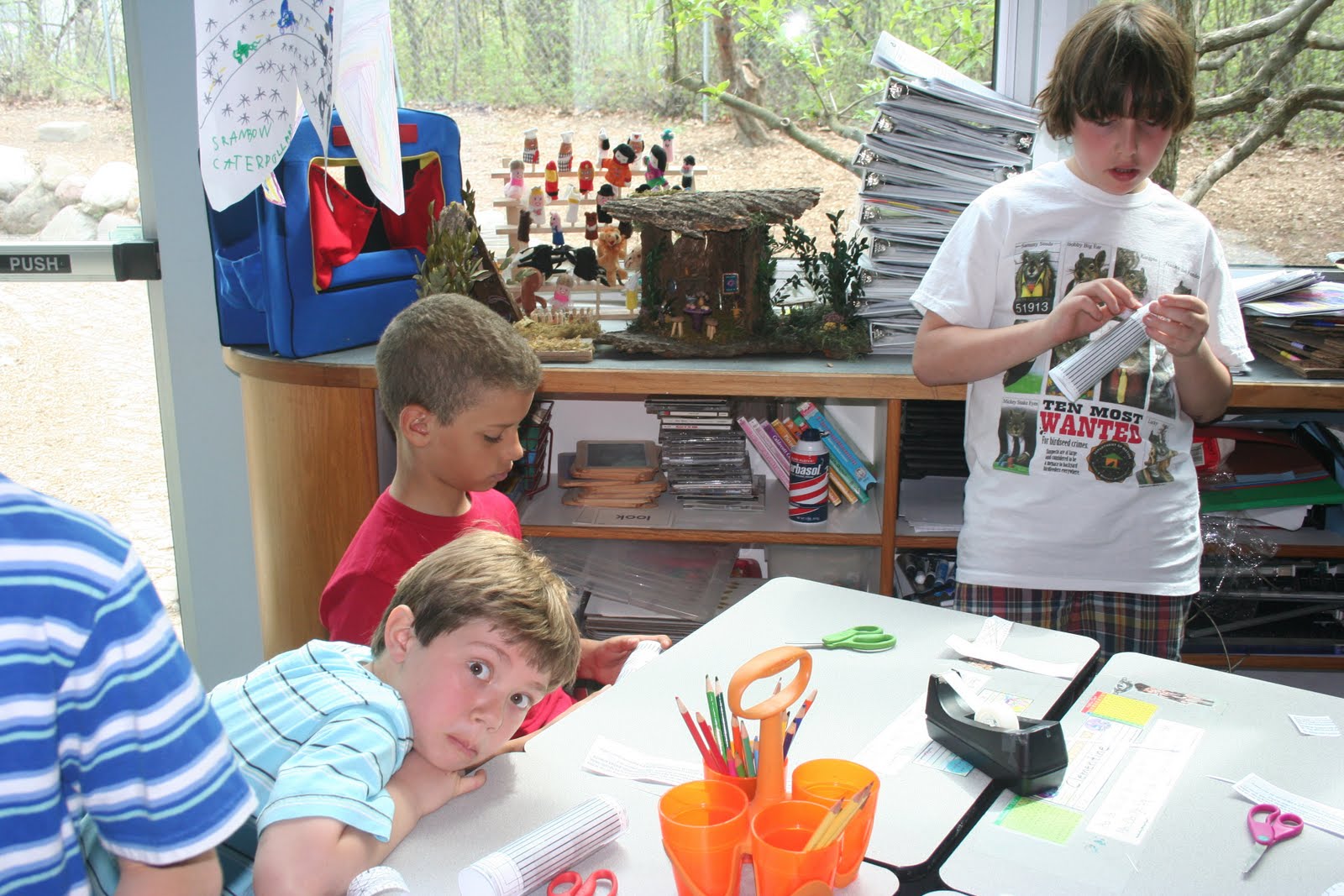
We made our own Enigma machines out of paper and tape. Here's the Enigma machine construction in progress:


Using the engima machine to decode a message:


There's a nice article here about how the Engima machine works and about some of the things that helped the Allies figure out what was going on.

Cryptology - The Alphabet Clock

In classes 3 and 4 we learned about modular arithmetic and the one-time pad.

Modular arithmetic is the sort of arithmetic you do on a clock. On a normal clock, if you start at 7 and add 11 hours you end up at 6. Mathematicians would write it like this:
7+11 = 6 mod 12
(actually, we use three horizontal lines instead of two for the equal sign, but I don't know how to make that symbol on the blog). The "mod 12'' part means that we're on a clock with 12 numbers, starting with 0 at the top (instead of 12) and continuing around to 11.

For cryptology, we use a clock with the 26 letters on it. These correspond to the numbers from 0 to 25.
On the alphabet clock,
0 and 26 both mean A
1 and 27 both mean B
25 and -1 both mean Z
and so on.

To use this clock to encrypt a message, we need some starting plaintext and a key. A key is a secret bit of information that the person sending the message and the person receiving the message both have to know in order for this to work.

Let's use CHICKEN as the plaintext and MOOFAZA as the key.

We translate the plaintext and key into numbers, using the clock. We add the first number of plaintext and the first number of key, then the second number of plaintext and the second number of key, and so on.
plaintext   CHICKEN   2    7    8    2   10  4  13
key MOOFAZA 12 14 14 5 0 25 0
sum 14 21 22 7 10 29 13

Then we translate the numbers back into letters. On the alphabet clock, 29 and 3 are both D.

14 21 22 7 10 29 13
O V W H K D N

We send the ciphertext OVWHKDN.


To decrypt the message, we need to know the ciphertext and the key. Since we added the key to get the ciphertext, we have to subtract the key to get the plaintext. Translate the ciphertext and key into numbers, and take the difference between each pair of numbers:

ciphertext OVWHKDN 14 21 22 7 10 29 13
key MOOFAZA 12 14 14 5 0 25 0
difference 2 7 8 2 10 4 13

Finally we translate those numbers back into letters:

2 7 8 2 10 4 13
C H I C K E N

If the key is totally random and as long as the message, we have what's called a one-time pad. In one sense, this is the best cryptography there is: if you don't know the key, you can't figure out the message. I don't care how good your computer is - it can tell all the possible messages, but it can't tell which was the real one.


In another sense, this is horribly impractical. You have to get a gigantic list of completely random letters to your buddy, without anyone else seeing them, and you and your buddy have to always be at the same place in the gigantic list of letters. What a mess!

Wednesday, April 20, 2011

EB: Cryptology

The first class we learned about the Caesar Cipher and other shift ciphers, as well as learning some useful cryptology words.
  • Plaintext - the meaningful English message
  • Ciphertext - what you actually send; the secret coded message
  • Encrypt - turn the plaintext into ciphertext
  • Decrypt - turn the ciphertext back into plaintext
The students paired off and sent their partners encrypted messages to decrypt.

Today I gave the class several encrypted messages to break, of increasing degrees of difficulty. We worked them all out on the board. It was helpful that I forgot what the plaintext messages were!

Here's the first one:

MJQQT, HQFXX.
HTSLWFYZQFYNTSX TS GWJFPNSL YMNX HNUMJW!
- OJXXJ

This one is pretty easy. It looks like a letter, and I wrote it, so "OJXXJ" stands for "JESSE." The first word, "MJQQT," is "HELLO." Since I used a shift cipher, the rest follows from there.

For the next message, I didn't give them any helpful formatting.

KXNDRSCYXOKVCYFOBIXSMO

The most common English letter is "E," and the most common characters in this ciphertext are "X" and "O." I was still using a shift cipher, so there were really only two things to try. That didn't take long either.

Then, since they kept breaking my shift ciphers, I changed to a cipher that randomly mixed up the letters. I did give them back the formatting, though - I didn't want it to be impossible (or take more than the hour-long class)!

VCPT PT E DPYYRHRNV VMSR FY ZFDR

The letter "E" in the ciphertext is a one-letter word, so it must be either "I" or "A" (assuming I'm using grammatical English!). The class went with "A".

Then the two-letter words in the ciphertext, "PT" and "FY," must translate to two-letter English words that don't contain the letter "A." Also, the two-letter word "PT" is the second half of the four-letter word "VCPT." It was agreed that "THIS IS" was a reasonable guess at those first two words.

From there, they got the answer!

The picture shows, from left to right:
  • The ciphertext-to-plaintext translation (we used this more for the first two puzzles)
  • The ciphertext, with plaintext underneath
  • A list of common 2-letter English words

Tuesday, April 19, 2011

More Killer Sudoku

Yesterday and today we worked on this puzzle. Renata and I were impressed with how well everyone worked on it - almost every moment was full of raised hands and kids saying "I know something!" We finished before the end of class!


Thursday, April 14, 2011

Origami and Pascal's Triangle

The first quarter of April was spring break, and we haven't had time to do a whole lot since then. We've made some neat origami vases and boxes. The vase required folding the paper exactly in thirds, so we had to figure out how to do that (Google "origami thirds" and you'll find several different ways).

We also did a little more stuff with Pascal's Triangle. If we left-justify all the numbers, we get a staircase instead of a pyramid:

1
1 1
1 2 1
1 3 3 1
1 4 6 4 1
1 5 10 10 5 1

If we sum the numbers in each row, we get doubles:

Sum
1 1
1 1 2
1 2 1 4
1 3 3 1 8
1 4 6 4 1 16
1 5 10 10 5 1 32

If we sum the numbers on each finite diagonal, we get the Fibonacci numbers. I think this is really cool.

Sum
1 1
1 1 1
2 1 2 1
3 1 3 3 1
5 1 4 6 4 1
8 1 5 10 10 5 1