Thursday, January 13, 2011

Killer Sudoku, cont.

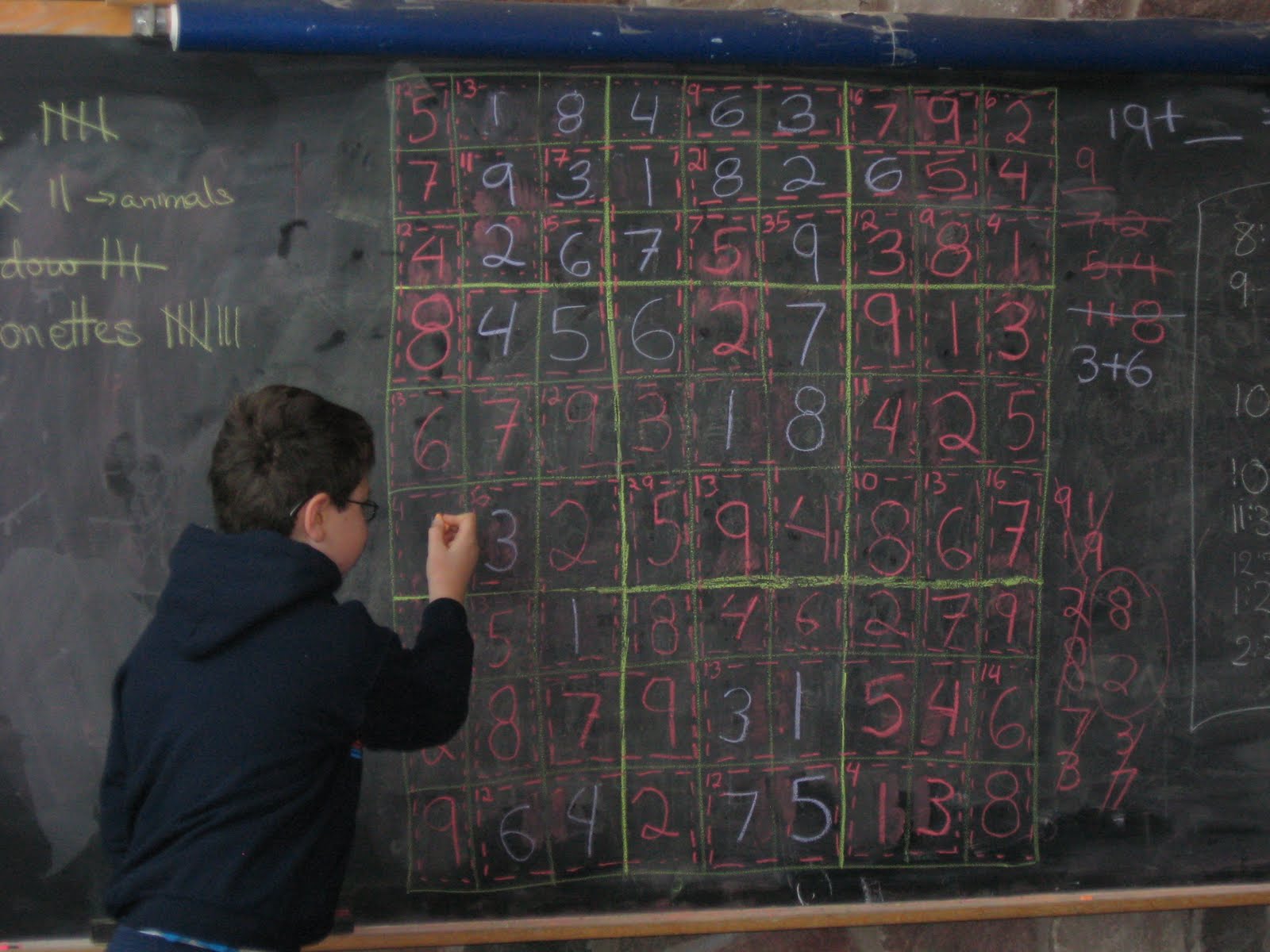
We finished the Killer Sudoku! Here it is, in all its glory:

And here's Saul posing with the finished puzzle:
Wednesday, January 12, 2011

Perimeter and City Blocks

At some point in your life you were probably asked a question like this: what is the perimeter of this shape?

This is known as a "composite" shape, and kids are taught to find the perimeter of such a thing by looking at it as a bunch of rectangles stuck together, finding the length of each little line, and then adding the lengths. This is a fine method, works great. However, when the shapes are particularly nice, there's a much easier way.

This easier way is based on how we measure distances in a city. Assuming we can't cut through buildings, we measure distances in a city by blocks. In the picture below, the distance from A to B is 7 blocks. Any reasonable path from A to B must go a total of 4 blocks East and 3 blocks North. We don't have to do all the traveling East at once - we might go 1 block E, then 3 blocks N, then 3 blocks E. We've still travelled a total of 4 blocks E and 3 blocks N.

This brings us back to the original question, how to find the perimeter of the composite shape. We can think of this shape as being made of two paths from A to B, where each path uses only the directions E and N.
Looking at the "lower" path, we see that to travel from A to B one must go a total of 24 blocks E and 15 blocks N. Although we aren't given any distances on the "upper" path, we know that the red line segments on the upper path must take us the same distance East as the red line segments on the lower path (24 blocks). Similarly, the black line segments on the upper path must take us the same distance North as the black line segments on the lower path (15 blocks).

The upper and lower path each go 24 blocks E and 15 blocks N, so the total perimeter is
2(24+15)=2(39)=78.

Warning: this trick is just for shapes made up of two paths that only travel East and North!

Tuesday, January 11, 2011

My first math publication!

About two years ago I submitted a paper to the journal "Discrete Mathematics." I got the response "revise and resubmit" (translation: "make some changes, then we'll look at it again"). I revised and resubmitted and got the same response. I revised and resubmitted. Last week, I got a different response: my paper has been accepted for publication!

The name of the paper is "Improved Upper Bounds for the Information Rates of the Secret Sharing Schemes Induced by the Vamos Matroid." There are very few people in the world who know exactly what that means.

To summarize the punchline, there's a number x that mathematicians know is less than 10/11 (about .91) and a number y that mathematicians know is less than 9/10 (.9). I showed that x has to be less than 8/9 (about .89) and y has to be less than 17/19 (about .895). This probably doesn't sound like a big deal, but it was a big enough deal for the paper to get accepted! A surprisingly large amount of math consists of chipping away at numbers like this.

My favorite part is the way I showed that x and y had to be smaller than previously thought. Instead of using equations, I found a way to prove things using pretty pictures. :)

Wednesday, January 5, 2011

Killer Sudoku

"Killer Sudoku" is like normal sudoku but with a twist. Instead of being given some numbers to start with, you're told what certain groups of cells add up to. For example, if you know that the numbers in two cells must add up to 17, you know the number in one cell must be 8 and the other must be 9 (although you don't know which number goes in which cell).

Today we started work on this puzzle. The kids felt like it was going very slowly because we weren't able to fill in many numbers, but they were making great progress at narrowing down the options, which is how it goes with these puzzles!

Tuesday, January 4, 2011

A General Thank-You

Thank you to all the families who chipped in for the gift card! I'm having fun deciding how best to use it at Bellanina. :)

I hope everyone had a nice holiday season, and wish you all the best for 2011!

Jesse

Coloring

New year, new math. I'm tired of origami (the three-headed dragon took a very long time), so we're moving on.

Right now we're working on coloring "maps." The "maps" are drawings with various shapes, and each shape is considered its own country - no funny stuff like Alaska not being attached to the rest of the US.

When coloring, two countries that share a border aren't allowed to be the same color. If two countries only touch at a corner (like Utah and New Mexico in the 4 corners), they are not considered to share a border, so they are allowed to be the same color.

The challenge: given a map, how many colors do you need to be able to color it following the rules? Use the smallest number of colors you can get away with.

Here's an example:
We can't color this following the rules with only 1 color, or with 2. What about 3? Maybe we need 4, or 5.

I gave the kids a bunch of maps (this was the hardest one) and for each map they figured out the smallest number of colors they could get away with. Then they drew their own maps and started figuring out how many colors they would need for those.

Thursday, December 2, 2010

Adventures in Origami

I've been on an origami kick recently, and encouraging the habit in the kids.

Origami is useful for a great many things: fine motor control, intuitive understanding of symmetry ("now fold it the same way on the other side"), and three-dimensional visualization ("hold your model in the same orientation as the picture"), to name a few. It's an activity where being careful really does matter if you want to end up with something recognizable, and where practicing makes you better pretty quickly.

Origami EB

During this six-week class we made paper cranes, warblers, and Sonobe Units which can be assembled to form a cube. My favorite class was the one where we made paper cranes out of pieces of paper that started as 5-foot squares!

Three-Headed Dragons

Lukas, Alec, and Max are currently working on the three-headed dragon designed by John Montroll. This is a study in persistence. So far we've spent at least two hours on this beast, and we might be halfway done. The dragons, mine included, currently look like blobs with little tails sticking out.

Area and Volume

Start with a small square piece of paper, side length s. The area of a big square piece of paper with side length 2s is 4 times the area of the small paper, as we can see by putting 4 pieces of origami paper next to each other.

If we make a cube with small pieces of paper (side length s), we get a small cube. If we make a cube with big pieces of paper (side length 2s), we get a big cube. How many small cubes fit inside the big cube? Guesses included 4, 5, 6, 8, and 16. By making a big cube and putting a small cube inside it, we could see that 2 layers of 4 small cubes, for a total of 8, would fit inside.